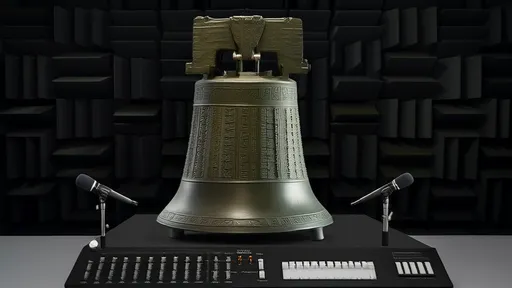
The recent advancements in acoustic archaeology have brought to light fascinating discoveries about ancient musical instruments, particularly the renowned Zeng Houyi chime bells. These artifacts, dating back to the Warring States period (475–221 BCE), represent a pinnacle of bronze metallurgy and musical engineering. Among the most intriguing aspects of these bells is their ability to produce two distinct tones, a feature that has puzzled and fascinated researchers for decades. The latest efforts in frequency restoration have shed new light on how these ancient craftsmen achieved such acoustic precision.
The Zeng Houyi chime bells, unearthed in 1978 from the tomb of Marquis Yi of Zeng in Hubei Province, China, consist of 65 bronze bells arranged in three rows. Each bell is capable of producing two separate musical notes when struck at different locations, a phenomenon known as "dual-tone" capability. This sophisticated acoustic property suggests an advanced understanding of sound physics long before the formal development of Western acoustical theory. The restoration of these frequencies has become a crucial endeavor in understanding ancient Chinese musical scales and their cultural significance.
Modern acoustic archaeologists have employed a combination of cutting-edge technologies and traditional craftsmanship to unravel the secrets of these ancient instruments. Using laser Doppler vibrometry and advanced spectral analysis, researchers have mapped the vibrational patterns of the bells with unprecedented precision. These studies reveal that the dual-tone phenomenon results from carefully calculated thickness variations in the bell walls, creating specific nodal points that produce different frequencies when struck. The ancient artisans achieved this through an intricate process of tuning that involved meticulous scraping and polishing of the bronze surface.
The frequency restoration project has faced numerous challenges, particularly in accounting for the physical changes the bells have undergone over millennia. Corrosion, metal fatigue, and previous restoration attempts have all altered the original acoustic properties of the instruments. To overcome this, researchers have developed sophisticated computer models that simulate the bells' original condition based on metallurgical analysis of the bronze alloy composition and manufacturing techniques. These models allow scientists to "hear" the bells as they would have sounded when first created, providing invaluable insights into ancient Chinese music theory.
One of the most significant findings from this research is the demonstration of the bells' remarkable consistency in musical temperament across the entire set. The restored frequencies reveal a sophisticated understanding of interval relationships that predates similar developments in Western music by centuries. The bells were tuned to what modern musicians would recognize as a seven-tone scale, with the dual-tone capability allowing for complex harmonic possibilities. This discovery challenges previous assumptions about the evolution of musical scales and suggests a highly developed musical culture in ancient China.
Cultural implications of these findings extend far beyond musicology. The precision and craftsmanship evident in the chime bells reflect the importance of ritual music in Zhou dynasty society. Music was not merely entertainment but a fundamental aspect of statecraft and cosmic harmony in ancient Chinese philosophy. The ability to recreate these sounds allows modern scholars to better understand the sensory experience of ancient rituals and ceremonies. Furthermore, the technological sophistication of the bells demonstrates that ancient Chinese metallurgists possessed knowledge of material science that rivaled, and in some aspects surpassed, contemporary civilizations in other parts of the world.
The restoration process has also revealed surprising details about the manufacturing techniques. Analysis of the frequency patterns suggests that the ancient craftsmen used a system of standardized measurements and proportions that ensured consistency across the entire set of bells. This standardization implies the existence of formalized knowledge transmission among bronze workers, possibly through guilds or apprenticeship systems. The precision required to achieve the dual-tone effect would have demanded not only technical skill but also a deep theoretical understanding of acoustics.
Future directions for this research include creating physical replicas based on the frequency restoration data to allow for practical musical performance. While the original bells are far too precious to be played regularly, accurate replicas could enable musicians to explore the ancient musical repertoire as it was intended to be heard. Additionally, researchers hope to apply similar acoustic archaeology techniques to other ancient instruments, potentially uncovering lost musical traditions from civilizations around the world.
The Zeng Houyi chime bells stand as a testament to human ingenuity across the ages. Through the painstaking work of acoustic archaeologists, we are gradually recovering not just the physical artifacts of ancient cultures, but the very sounds that shaped their worldviews and daily lives. As frequency restoration techniques continue to improve, we may find ourselves listening to the past with ever greater clarity, bridging the gap between modern science and ancient artistry in ways previously unimaginable.

By /Aug 5, 2025

By /Aug 5, 2025

By /Aug 5, 2025
By /Aug 5, 2025

By /Aug 5, 2025

By /Aug 5, 2025

By /Aug 5, 2025

By /Aug 5, 2025

By /Aug 5, 2025

By /Aug 5, 2025

By /Aug 5, 2025

By /Aug 5, 2025

By /Aug 5, 2025

By /Aug 5, 2025

By /Aug 5, 2025

By /Aug 5, 2025

By /Aug 5, 2025

By /Aug 5, 2025

By /Aug 5, 2025

By /Aug 5, 2025