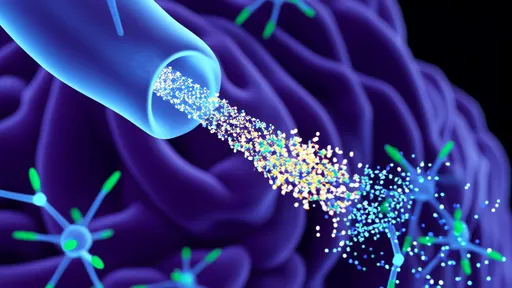
For decades, neuroscientists have grappled with the challenge of observing neurotransmitter activity in real time. The elusive dance of dopamine—a chemical messenger tied to pleasure, motivation, and disease—has remained largely invisible to conventional imaging techniques. Now, a groundbreaking fusion of nanotechnology and neuroscience is rewriting the rules of observation. Quantum dot neurocinema, an emerging imaging paradigm, is allowing researchers to capture dopamine release with unprecedented spatial and temporal resolution, effectively creating molecular-scale movies of the brain's reward system in action.
The technique hinges on engineered semiconductor nanocrystals—quantum dots—whose photoluminescent properties change when they interact with specific neurotransmitters. Unlike traditional fluorescent reporters that bleach quickly or require genetic modification, these quantum dots can be targeted to dopamine receptors or transporters while maintaining exceptional brightness over hours of imaging. When dopamine molecules bind to their receptors, the quantum dots emit distinct spectral shifts, creating an optical fingerprint of neurotransmitter release events.
What sets this approach apart is its ability to resolve dopamine transients at the synaptic level while maintaining brain-wide observational capacity. Early experiments in rodent models have revealed previously undetectable patterns of dopamine signaling, including rapid-fire "bursts" of release that last mere milliseconds. These fleeting signals, which conventional microdialysis or voltammetry methods would miss entirely, appear to carry specialized information about reward prediction and motivational salience.
The implications extend far beyond basic research. Parkinson's disease, addiction, and depression all involve dysregulated dopamine systems, yet current diagnostic tools provide only crude snapshots of neurotransmitter function. Quantum dot imaging offers the possibility of tracking these conditions with molecular precision, potentially identifying pathological signaling patterns before structural neurodegeneration occurs. Pharmaceutical researchers are particularly interested in using the technology to observe how experimental drugs modulate dopamine release kinetics in real time.
Technical hurdles remain before widespread adoption. Delivering quantum dots across the blood-brain barrier requires sophisticated targeting strategies, and long-term biocompatibility studies are ongoing. However, recent advances in surface chemistry have yielded quantum dot formulations that resist degradation while minimizing cellular toxicity. Some research groups are experimenting with biodegradable variants that break down after several weeks of imaging.
Ethical considerations accompany these technological leaps. The same methods that could illuminate addiction pathways might also be adapted for neuromodulation or behavioral control. Neuroscience communities are proactively establishing guidelines for responsible use, emphasizing therapeutic applications over enhancement. Meanwhile, the fundamental science continues to surprise—early adopters of quantum dot neurocinema report observing dopamine "waves" that propagate through neural circuits in coordinated patterns, suggesting organizational principles more complex than previously imagined.
As the technology matures, researchers anticipate capturing entire neurotransmitter "conversations" between dopamine, serotonin, and other signaling molecules. Multispectral quantum dot arrays now in development could simultaneously track multiple neurotransmitters, revealing how these chemical systems interact rather than operating in isolation. Such capabilities would transform our understanding of everything from decision-making to consciousness itself.
The convergence of nanotechnology and neuroscience heralds a new era of biological observation—one where molecular events play out like scenes in a cinematic masterpiece. With quantum dots as their lens, scientists are no longer limited to inferring dopamine activity from indirect measures; they can watch the brain's reward system operate in vivid, dynamic detail. This revolution in imaging promises not just to answer longstanding questions about brain function, but to reveal entirely new categories of questions we've never thought to ask.

By /Aug 5, 2025

By /Aug 5, 2025

By /Aug 5, 2025

By /Aug 5, 2025

By /Aug 5, 2025

By /Aug 5, 2025

By /Aug 5, 2025

By /Aug 5, 2025

By /Aug 5, 2025

By /Aug 5, 2025

By /Aug 5, 2025
By /Aug 5, 2025

By /Aug 5, 2025

By /Aug 5, 2025

By /Aug 5, 2025

By /Aug 5, 2025

By /Aug 5, 2025

By /Aug 5, 2025

By /Aug 5, 2025

By /Aug 5, 2025