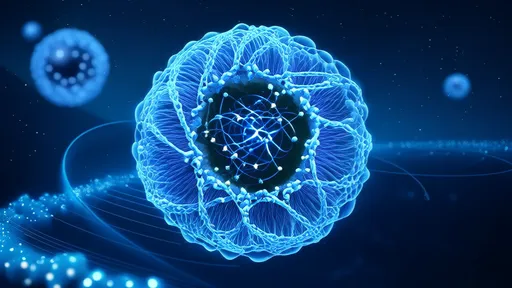
In the intricate dance of viral replication, few processes are as visually stunning – or as scientifically revealing – as the structural metamorphosis of viral capsids. Recent breakthroughs in cryo-electron microscopy (cryo-EM) have allowed researchers to capture unprecedented details of these shape-shifting protein shells during critical stages of their assembly and disassembly. The findings, published across several high-profile studies, rewrite our understanding of how viruses package their genetic material and prepare for new infections.
The term "viral shape-shifting" takes on literal meaning when observed through the lens of modern structural biology. Unlike the static models found in textbooks, viral capsids prove to be dynamic architectures that breathe, twist, and reorganize themselves with remarkable precision. Cryo-EM snapshots now reveal these transformations at near-atomic resolution, showing how protein subunits perform their carefully choreographed ballet to either encapsulate viral genomes or release them upon cell entry.
One particularly striking discovery involves the hidden symmetry breaks that govern capsid reorganization. While many viruses appear perfectly symmetrical in their mature form, the assembly process often requires temporary asymmetrical states that serve as molecular switches. These transitional configurations, once thought too fleeting to capture, have now been frozen in action by cryo-EM techniques. The resulting images show protein subunits adopting slightly different conformations to accommodate the growing nucleic acid payload or respond to environmental triggers.
The technological leap enabling these observations comes from advancements in direct electron detection and computational processing. Modern detectors can now count individual electrons with exquisite sensitivity, while improved algorithms can sort through thousands of particle images to reconstruct three-dimensional density maps. This combination allows researchers to visualize not just one static structure, but a continuum of conformational states present in the sample. The approach has proven particularly powerful for studying pleomorphic viruses that lack rigid symmetry.
Beyond basic science, these structural insights carry significant implications for antiviral development. The transient states captured during capsid reorganization represent potential vulnerabilities that could be targeted by new classes of drugs. Pharmaceutical researchers are particularly interested in compounds that might lock the capsid in nonfunctional configurations – either preventing proper genome packaging or inhibiting uncoating during infection. Several such capsid inhibitors are already showing promise in clinical trials for HIV and other chronic viral infections.
Perhaps most surprisingly, the cryo-EM revolution has revealed how much we've underestimated the mechanical sophistication of viral capsids. What were once considered simple containers now appear as molecular machines with moving parts, allosteric regulation, and even proofreading mechanisms. Some capsids appear to undergo quality control checks during assembly, rejecting improperly packaged genomes. Others demonstrate the ability to repair minor defects in their protein lattice, ensuring structural integrity despite environmental stresses.
The field continues to push resolution boundaries, with some labs now achieving structures below 2Å. This level of detail begins to show not just the positions of amino acids, but the water molecules and ions that mediate critical interactions. Meanwhile, time-resolved cryo-EM methods are being developed to capture structural changes on millisecond timescales. Together, these advances promise to transform our understanding of viral life cycles and open new frontiers in structural biology.
As research progresses, scientists are discovering unexpected commonalities between viruses from different families. The principles governing herpesvirus capsid assembly share surprising similarities with those in much smaller parvoviruses. Such conservation suggests that fundamental physical constraints may shape viral evolution across broad taxonomic ranges. This realization could lead to more broadly effective antiviral strategies that target universal aspects of capsid dynamics rather than virus-specific details.
The story emerging from these high-resolution studies paints viruses not as simple parasites, but as master architects of nanoscale engineering. Their capsids represent solutions to extraordinary challenges: packaging lengthy nucleic acids into minimal volumes, maintaining stability while allowing controlled disassembly, and evading host defenses through constant innovation. As cryo-EM continues to reveal these marvels of natural engineering, researchers gain both deeper appreciation for viral complexity and better tools to combat viral diseases.
By /Aug 5, 2025

By /Aug 5, 2025
By /Aug 5, 2025

By /Aug 5, 2025

By /Aug 5, 2025

By /Aug 5, 2025

By /Aug 5, 2025

By /Aug 5, 2025

By /Aug 5, 2025
By /Aug 5, 2025

By /Aug 5, 2025
By /Aug 5, 2025
By /Aug 5, 2025
By /Aug 5, 2025

By /Aug 5, 2025

By /Aug 5, 2025

By /Aug 5, 2025

By /Aug 5, 2025

By /Aug 5, 2025

By /Aug 5, 2025