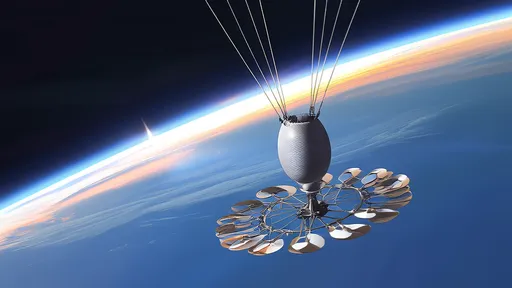
The quest for renewable energy has taken engineers to new heights—literally. In recent years, researchers have been developing ambitious systems to harness wind power from an unlikely location: the stratosphere. At altitudes around 20 kilometers above Earth's surface, a technological revolution is quietly taking shape with helium-balloon-tethered aerial wind turbines that could fundamentally change how we generate clean electricity.
The Stratospheric Wind Advantage
Traditional wind turbines face inherent limitations based on their ground-based or offshore locations. Surface winds are inconsistent, affected by terrain, weather patterns, and daily temperature variations. The stratosphere offers something remarkably different—consistent high-altitude winds that blow with far greater speed and reliability. At 20km altitude, jet stream winds frequently exceed 200 km/h and maintain about 80% availability compared to 30-40% for terrestrial wind farms.
This altitude represents what engineers call the "wind power sweet spot"—high enough to catch ultra-strong winds but low enough to remain below orbital space infrastructure. The energy density at these heights is staggering; a single stratospheric turbine could generate 5-10 times more power than its ground-based counterpart of similar size. When you consider that winds at this elevation circle the entire planet, the potential for continuous energy generation becomes apparent.
Engineering the Impossible
The core technology involves three critical components: the helium aerostat (balloon), the tether system, and the power generation/transmission equipment. Modern materials science has made this possible where it would have been fantasy just two decades ago. The balloons use advanced composite fabrics—layers of graphene-enhanced polyurethane with helium barrier coatings—that maintain structural integrity against extreme cold (-60°C), low pressure, and UV radiation.
The real engineering marvel lies in the tether. This isn't ordinary rope but a multilayered umbilical cord containing power conductors, data fibers, and load-bearing members made from ultra-high-molecular-weight polyethylene fibers. These "super ropes" combine the strength of steel with just 5% of the weight. Some designs incorporate conductive nanomaterials that serve dual purposes as both structural elements and electricity transmission lines.
Power generation happens through two primary methods: turbine arrays mounted directly on the balloon structure, or through a ground-based generator that reels the tether in/out to create mechanical energy. The airborne turbine approach places vertical-axis wind turbines around the balloon's equator, while the ground-station method uses the constant tension between balloon lift and wind drag to drive massive winch generators.
Overcoming Technical Challenges
Developing stratospheric wind systems hasn't been without obstacles. The first major hurdle was creating autonomous control systems that could maintain station-keeping without constant human intervention. Modern systems use GPS positioning with AI-driven altitude adjustment—releasing small amounts of helium or taking on ballast water to maintain optimal positioning within the wind stream.
Lightning protection became another critical design focus. Engineers developed conductive outer layers that safely channel strikes along the tether to deep-ground electrodes. Similarly, collision avoidance systems combine transponders with radar reflectors to alert aircraft while machine learning algorithms predict and prevent potential conflicts with flight paths.
Perhaps most impressively, researchers solved the diurnal problem—the tendency for balloons to descend at night when cooling reduces helium volume. Phase-change materials in the envelope and compressors that adjust gas pressure now maintain near-constant lift regardless of temperature fluctuations.
Economic and Environmental Potential
The economics of stratospheric wind appear increasingly favorable. While individual systems carry high upfront costs (approximately $2-5 million per unit), their energy output and capacity factors lead to levelized costs competitive with—and potentially lower than—traditional renewables. A single 600kW system can power about 300 homes continuously, compared to needing three conventional turbines for similar output due to intermittency.
From an environmental standpoint, these systems offer extraordinary advantages. The manufacturing footprint is about 10% of equivalent-output ground turbines, using 95% less concrete and steel. They produce no noise pollution for nearby communities and have minimal visual impact—the balloons appear as faint stars even at twilight. Wildlife impact appears negligible based on early environmental studies, though long-term monitoring continues.
Perhaps most significantly, stratospheric wind could provide baseload renewable power without the geographic limitations of ground-based alternatives. Desert regions, mountainous areas, and even coastal waters could host these systems without competing for valuable land resources. Early adopters include island nations and remote communities where diesel generation currently dominates.
Current Projects and Future Scale
Several pioneering companies have moved from prototype to pilot projects. Altaeros Energies deployed the first commercial system in Alaska in 2022, replacing diesel generators for an isolated community. Their "BAT" (Buoyant Airborne Turbine) system operates at 600m altitude—a stepping stone toward full stratospheric designs. Meanwhile, European consortium SkySails Power has logged over 5,000 hours on their 200kW system off the German coast.
The coming decade will likely see exponential growth. Energy analysts project the stratospheric wind market could reach 3GW installed capacity by 2035, representing a $12 billion industry. This growth will depend on solving remaining challenges like large-scale helium sourcing (though closed-loop systems recover over 90% of gas) and developing international flight regulations for "wind farms" in shared airspace.
Looking further ahead, researchers envision networks of these systems creating continental-scale renewable grids. Computer models show that strategically placed arrays could provide consistent power across regions by leveraging global wind patterns. Some futuristic concepts even propose using excess power to produce hydrogen at altitude or serve as communications relays—creating multi-function aerial platforms.
The Road Ahead
As climate change accelerates the transition from fossil fuels, stratospheric wind offers a compelling piece of the renewable energy puzzle. While not a silver bullet, it represents one of the few technologies capable of delivering utility-scale power with minimal environmental disruption. The coming years will prove whether this high-flying vision can achieve its potential, but early results suggest we may indeed be witnessing the birth of a new energy paradigm—one that quite literally rises above traditional limitations.
The development mirrors humanity's historical energy transitions—from burning wood at ground level, to digging for coal underground, to drilling for oil beneath seas, and now to harvesting wind where it blows strongest, 20 kilometers above our heads. In this context, reaching for the stratosphere seems not just ambitious, but inevitable.

By /Aug 5, 2025
By /Aug 5, 2025

By /Aug 5, 2025
By /Aug 5, 2025
By /Aug 5, 2025

By /Aug 5, 2025

By /Aug 5, 2025
By /Aug 5, 2025

By /Aug 5, 2025

By /Aug 5, 2025

By /Aug 5, 2025

By /Aug 5, 2025

By /Aug 5, 2025

By /Aug 5, 2025
By /Aug 5, 2025
By /Aug 5, 2025
By /Aug 5, 2025
By /Aug 5, 2025
By /Aug 5, 2025
By /Aug 5, 2025