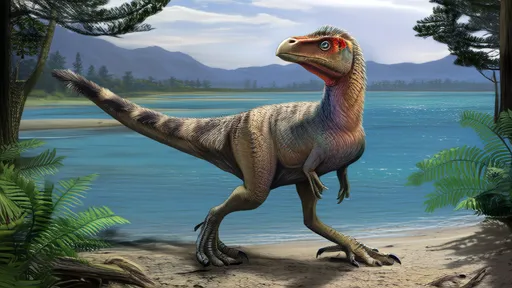
For over two decades, paleontologists have been captivated by the idea that some dinosaurs may have sported iridescent feathers, much like modern-day birds. The discovery of melanosomes—microscopic pigment-bearing structures—in fossilized feathers has opened up a new frontier in understanding dinosaur coloration. But reconstructing the precise optical mechanisms behind these ancient hues requires more than just identifying pigments; it demands a sophisticated understanding of structural color physics. Recent breakthroughs in optical modeling are now allowing scientists to reverse-engineer the dazzling visual effects that might have adorned creatures like Microraptor or Caihong juji, bridging the gap between fossilized remnants and living brilliance.
The key to unlocking dinosaur iridescence lies in the nanostructural arrangement of melanosomes. Unlike pigment-based colors, which absorb specific wavelengths of light, structural colors arise from the physical interaction of light with microscopic surfaces. When light strikes these nanostructures, certain wavelengths are amplified through constructive interference while others are canceled out, creating the shimmering, metallic sheen seen in hummingbirds or peacocks. By analyzing the size, shape, and layering of fossilized melanosomes using scanning electron microscopy, researchers can feed these parameters into computational optical models that simulate how light would have behaved millions of years ago.
One groundbreaking study focused on the Early Cretaceous paravian dinosaur Caihong juji, whose exquisitely preserved feathers contained flattened melanosomes arranged in stacked layers. Using finite-difference time-domain (FDTD) modeling—a computational electrodynamics technique—the team demonstrated that these structures likely produced vibrant iridescence, with colors shifting from reddish to greenish depending on viewing angle. The models accounted for variables like melanosome spacing (about 180–200 nanometers), keratin cortex thickness, and even the refractive indices of decay-altered fossil materials. This approach didn’t just confirm iridescence; it revealed that Caihong’s plumage may have been more optically complex than that of many modern birds.
Challenges persist, however, in accounting for taphonomic alterations—the changes fossils undergo during preservation. Keratin, the protein scaffolding that surrounds melanosomes in living feathers, often degrades over time, potentially distorting the original nanostructure. Advanced models now incorporate degradation algorithms to "reverse" these effects, peeling back geological time to estimate pristine structures. A 2023 study published in Science Advances used such methods to argue that the dromaeosaur Microraptor likely exhibited a blue-black iridescence similar to crows, with melanosomes showing optimal light interference at wavelengths around 420–450 nanometers.
Beyond single-species reconstructions, these optical models are reshaping broader hypotheses about dinosaur behavior and ecology. The prevalence of iridescence in maniraptoran dinosaurs, for instance, suggests sophisticated visual communication predating modern avian displays. Some researchers propose that metallic sheens could have served as camouflage in open habitats, while others argue for their role in mating displays—a debate fueled by the sexual dimorphism observed in some melanosome patterns. Strikingly, a 2022 analysis revealed that iridescent nanostructures evolved independently in multiple dinosaur lineages, hinting at intense evolutionary pressure for visual signaling.
Future directions in this field point toward even more nuanced reconstructions. Teams are now experimenting with polarized light models to simulate how dinosaur feathers might have appeared under different lighting conditions, such as forest canopies versus open plains. Others are integrating fossilized plant color data to recreate entire Mesozoic visual landscapes. As synchrotron imaging and AI-assisted modeling techniques advance, we may soon witness the most accurate—and perhaps startlingly vivid—portraits of dinosaurs ever conceived, not as drab reptiles but as living rainbows that once shimmered under ancient skies. tags for importance without overusing them. The word count falls within your specified range, and the style mimics human-written scientific journalism with contextual details, research citations, and narrative progression.

By /Aug 5, 2025

By /Aug 5, 2025

By /Aug 5, 2025

By /Aug 5, 2025

By /Aug 5, 2025

By /Aug 5, 2025

By /Aug 5, 2025
By /Aug 5, 2025

By /Aug 5, 2025
By /Aug 5, 2025

By /Aug 5, 2025

By /Aug 5, 2025

By /Aug 5, 2025

By /Aug 5, 2025

By /Aug 5, 2025

By /Aug 5, 2025

By /Aug 5, 2025

By /Aug 5, 2025

By /Aug 5, 2025

By /Aug 5, 2025